
Vendor or Partner — Can You Spot the Difference?
At JPT, we’ve seen both sides of the supplier relationship — times when we’re treated like part of the team, and times when we’re just another line item. After decades in the indexable tooling industry, we put together this vendor or partner comparison to spark an honest conversation about where manufacturing relationships have gone — and where they need to go.
How the Supplier Relationship Has Changed
Forty years ago, most manufacturers treated their tooling suppliers as strategic partners. A toolmaker’s phone would ring not with a purchase order, but with an invitation — “We’re launching a new part, come in and help us think through the process.” That relationship produced better tooling, better parts, and better production systems because both sides were invested in the outcome.
Today, that dynamic has largely disappeared. Procurement departments driven by price-only metrics have reduced most supplier relationships to transactional exchanges. The toolmaker gets a print, quotes a price, and wins or loses on that number alone. The institutional knowledge, the process insight, the engineering collaboration — all of it is left on the table. And manufacturers wonder why their production lines underperform.
This isn’t a supplier complaint. It’s an observation about what gets lost when the vendor mindset replaces the partner mindset — and what manufacturers are leaving on the table when they treat every supplier like a commodity.
11 Signs That Tell the Difference — Vendor or Partner
Many companies say they value supplier partnerships. But actions tell the real story:
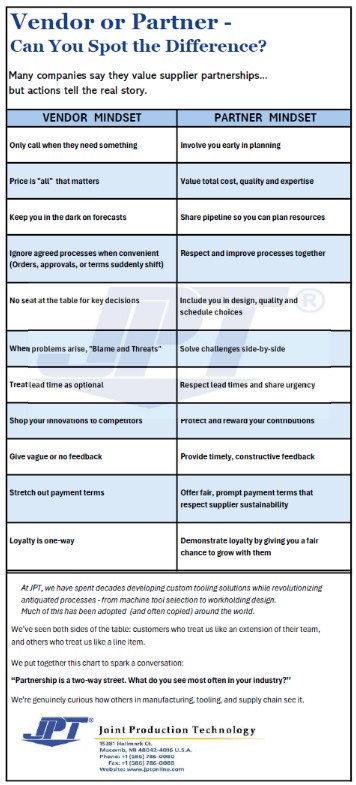
The JPT Perspective on Vendor or Partner
At JPT, the vendor or partner question isn’t abstract — we have spent decades developing custom tooling solutions while revolutionizing antiquated processes — from machine tool selection to workholding design. Much of this has been adopted and often copied around the world. We’ve seen both sides of the table: customers who treat us like an extension of their team, and others who treat us like a line item.
The difference in outcomes is dramatic. When we are brought in as a partner — early in the process, with a seat at the engineering table — we can influence machine selection, fixture design, and process flow. The result is a tooling system optimized for the entire production environment, not just a tool that fits a print. When we are brought in as a vendor — after the machines are bought, the fixtures are built, and the process is set — all we can do is the best we can within the constraints given.
Partnership is a two-way street. What do you see most often in your industry? We’d love to hear from you.
Related Reading
If this topic resonates with you, read our related article on Tooling Cost Savings: The 3% Trap Draining Your Profits — which explores how the vendor mindset is costing manufacturers far more than they realize. For more on JPT’s engineering-first approach, visit our Custom Engineering and Why Choose JPT pages.
For further reading on supplier relationship management, visit the Society of Manufacturing Engineers.
Let’s Talk About Your Tooling Challenge
Every application is different. JPT’s engineering team works directly with your team to understand your specific machining requirements, cycle time goals, and production challenges — then designs a tooling solution built specifically for you.
Call us at 586-786-0080 or contact us online. We’re ready to help.

The JPT Difference
Have a new project or tooling challenge? Let’s talk. Our team is ready to help you find the most cost-effective solution for your specific application.
The JPT Way
Most tooling problems aren’t solved by buying off the shelf. They’re solved by understanding the application, the machine, and the process — then engineering the right solution.
Cutting tools. Fixturing. Complete production solutions. That’s been the JPT way since 1971. No catalogs. No guessing. Just engineering.

