
JPT Taper Boring Motion Tool — Tapered Bores Without Reamers or Part Rotation
Machining Tapered Holes the “JPT Way”
The JPT taper boring motion tool machines precise tapered bores in a single controlled pass, with the taper built into the tool itself. It eliminates tapered reamers entirely, and it machines the taper from the opposite side of the part, which means the part never has to be rotated or indexed to reach the hole.
The tool generates the taper small to big or big to small, the same orientations available with a traditional tapered reamer, depending on how the part is presented. That flexibility means the tooling adapts to your fixture and part orientation rather than dictating it.
That single capability changes the economics of tapered bore production. Rotating a part to present the taper to a conventional reamer demands additional fixturing, an indexing operation, and the cycle time that goes with both. Machining from the opposite side removes all of it. For manufacturers running tapered bores in volume, this is where the savings come from.
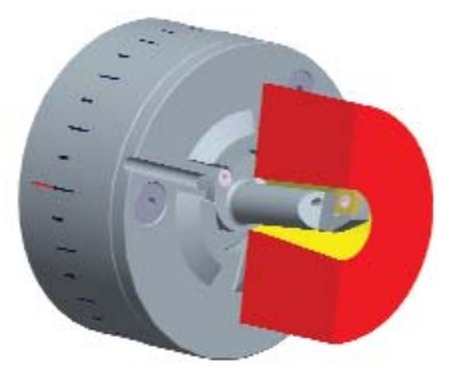
How the Taper Boring Motion Tool Works
Conventional tapered bore production relies on tapered reamers, which wear, drift in size, and require frequent replacement to hold tolerance. They also demand part rotation, which drives up fixturing cost and introduces high torque during the cut that can work against part seating and clamping.
The JPT taper boring motion tool takes a different approach. The taper geometry is built into the tool, and a controlled radial motion generates the taper as the tool feeds. Hole size is governed by part contact, referencing the workpiece itself rather than depending on the diameter of a consumable reamer. Size is then fine-tuned on the machine through micro-adjustment, so an operator can correct size at the spindle instead of pulling the tool for an off-machine setup.
Because size is controlled at the point of contact and adjusted in place, the process delivers repeatable results across long production runs. Operators are not chasing size as tooling wears, and the finished taper stays within specification part after part. Cutting geometry can be specified in exotic materials where the application calls for it, including silicon nitride, ceramics, cubic boron nitride, and polycrystalline diamond.
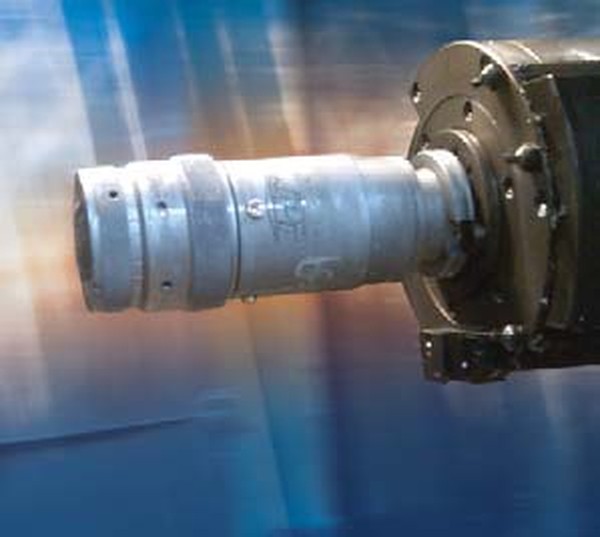
Two Versions — Chosen by How Your Machine Actuates the Tool
The right version depends entirely on the machine it will run on, and specifically on how that machine actuates the tool’s motion. Both versions share the same process and the same opposite-side advantage, but they are engineered for very different machine environments.
Drawbar Version — For Dedicated and Dial Machines
JPT developed the original taper boring system for dedicated dial machines, where the tool is physically linked to the machine through a drawbar connection. The machine’s drawbar actuates the tool directly, generally by pull, though push actuation is also possible. The drawbar drives the taper-generating motion, so the machine itself powers the cut.
Machine weight and rigidity are rarely a concern with this version. Dedicated machines built for this class of work are engineered like a bridge, deliberately over-specified in their dimensions, because the extra beef costs far less than a possible failure. That built-in margin means the requirement here is simply having a drawbar-equipped machine, not clearing a spindle-size or tool-weight hurdle.
CNC Version — Lost Motion, No Drawbar Required
The CNC version runs in the automatic tool changer of a standard machining center, where no machine drawbar is available. Instead it is a lost motion tool: part or fixture contact drives the taper-generating motion, and internal springs manage the lost motion on retract. The same contact principle that controls hole size also actuates the tool, which is what allows a self-contained motion tool to run in an ordinary tool changer with no drawbar connection at all.
This version can reside on most tool change machines and has run in production on horizontal machining centers with a CAT 50 tool shank.
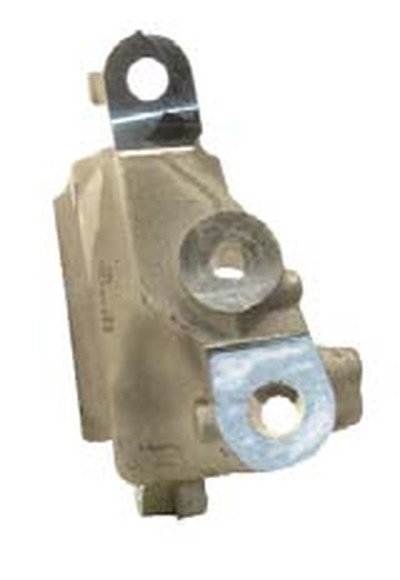
CNC Version Machine Requirements — Read Before You Quote
Because the CNC version is a self-contained tool hanging from the spindle in a tool changer, its machine requirement is firm. The tool weighs approximately 28 pounds and is substantial in length, and the machine must carry, hold, and drive it through the spindle taper alone. That demands a CAT50 or HSK-100 spindle connection.
A CAT40, BT40, or lighter spindle interface does not have the mass capacity, drawbar pull force, or rigidity to run the CNC version. This is not a limitation JPT can engineer around. It is a function of the physics of a heavy self-contained tool operating at production feeds and speeds, and JPT has declined applications specifically because the customer’s machine selection could not support the tool.
If you are specifying a machine for a tapered-bore part family, or evaluating whether an existing machine can run this process, contact us early. We will tell you directly whether your spindle interface is a fit before you commit to tooling, and if it is not, we will talk through your options, including whether the drawbar version and a dedicated machine make better sense for your part.
Proven in Production — Steering Knuckle Taper Bores
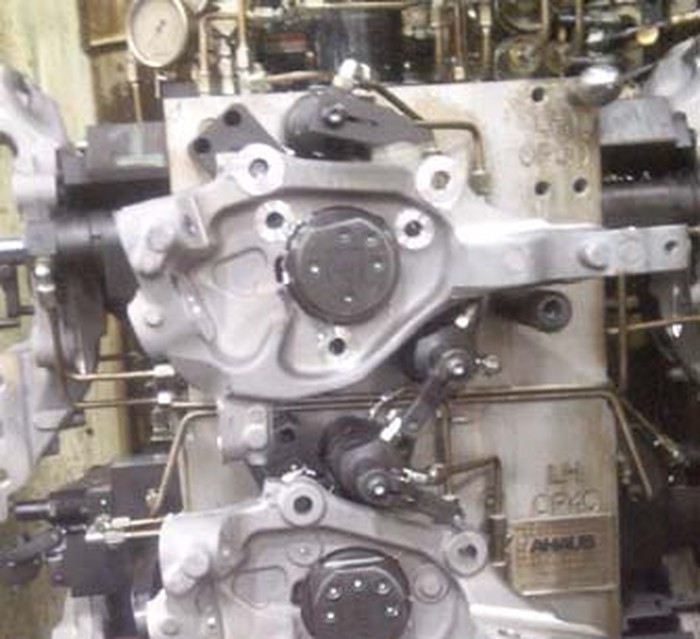
The proven, in-production application for this tooling is steering knuckle tooling in automotive and light truck manufacturing. Steering knuckles demand precise tapered bores held to tight tolerance at high volume, which is exactly the condition this tool was built for.
At one Michigan manufacturer, JPT was brought in to help meet a contractual requirement of 700 parts per day. The results were documented against the previous process: one-pass geometry replaced a two-pass rough-and-finish cycle, total cycle time dropped by roughly 88 percent, spindle speed more than doubled, and tool life improved by a factor of ten. Size control moved from an off-machine setup to on-machine micro-adjustment at the operator’s hand.
That system has now been in production for well over a decade. Multiple systems run at multiple locations, and every new steering knuckle at that customer is machined the JPT way.
The Trouble With Tapered Reamers
Manufacturers come to JPT because a reamed process has stopped working for them. The recurring complaints are consistent: part rotation is required and expensive to fixture, tool life is inconsistent, size control drifts, tapers vary from part to part, surface finishes disappoint, and torque during the cut climbs high enough to interfere with seating or clamping the part.
The taper boring motion tool addresses each of these directly. The taper is built into the tool rather than into a wearing reamer. Size is controlled by part contact and corrected on the machine. And because the bore is machined from the opposite side, the part never rotates at all.
Where the Taper Boring Motion Tool Fits
This tooling suits manufacturers with a common profile: production-volume tapered bore work, tight tolerance and finish requirements, and either a dedicated drawbar machine or a machining center built around a CAT50 or HSK-100 spindle. It is a fit for automotive powertrain and chassis components, heavy-duty and diesel applications, and any tapered-bore part where a reamed process cannot deliver the consistency or the cycle time the job demands.
Steering knuckles are where this tool has earned its reputation, but the process is not limited to that part. Any component with a demanding tapered bore is a candidate. If you are fighting reamer wear, size drift, part rotation, or cycle time on a tapered bore, this tool may be the answer, and JPT engineers each application to the specific part and machine.
More Than a Single Tool — The Full JPT Capability
The taper boring motion tool is one specialized solution among many. JPT designs and manufactures precision indexable cutting tools, fixturing, and complete machining systems for automotive, heavy equipment, aerospace, and defense manufacturers. Customers frequently come to us for one specific tool and discover we can solve several of their toughest machining problems.
If a tapered bore brought you here, it is worth seeing the rest of what we do. Explore our custom engineering capabilities, our differential case tooling systems, and our full range of special indexable tooling. JPT is ISO 9001:2015 certified and an active registered government supplier, verifiable through SAM.gov. We are also part of the manufacturing engineering community through the Society of Manufacturing Engineers (SME).
Let’s Talk About Your Taper Bore Challenge
Whether you are machining steering knuckles or a tapered bore on another part, running a dedicated drawbar machine or a CAT50 or HSK-100 machining center, JPT has the experience to tell you straight which version is right and whether your machine is a fit. Call us at (586) 786-0080 or contact us online to discuss your application.

The JPT Difference
Have a new project or tooling challenge? Let’s talk. Our team is ready to help you find the most cost-effective solution for your specific application.
The JPT Way
Most tooling problems aren’t solved by buying off the shelf. They’re solved by understanding the application, the machine, and the process — then engineering the right solution.
Cutting tools. Fixturing. Complete production solutions. That’s been the JPT way since 1971. No catalogs. No guessing. Just engineering.

