
Remember watching gas stations change their signs daily — sometimes several times a day — as the Strait of Hormuz crisis whipsawed oil markets? Pump prices surged 30% in a single month, fell back, then spiked again on a single day’s headlines. The pump is the one place most of us have ever watched a commodity reprice in real time — and it is the perfect way to understand what is happening to cutting tool material costs right now.
Now imagine that same volatility hitting materials with no sign on the corner: tungsten, cobalt, silver, alloy steel, aluminum. That is exactly what is happening to cutting tool material costs — except the moves are larger, the supply is more concentrated, and almost nobody outside the industry is watching. If you buy cutting tools, you have already felt it: quotes are higher, quote validity is shorter, and lead times are less certain. This is not opportunistic pricing. It is the sharpest simultaneous raw material cost escalation our industry has seen in decades. At Joint Production Technology, we believe our customers deserve a clear, documented explanation of what is happening and why. Here it is, with sources.
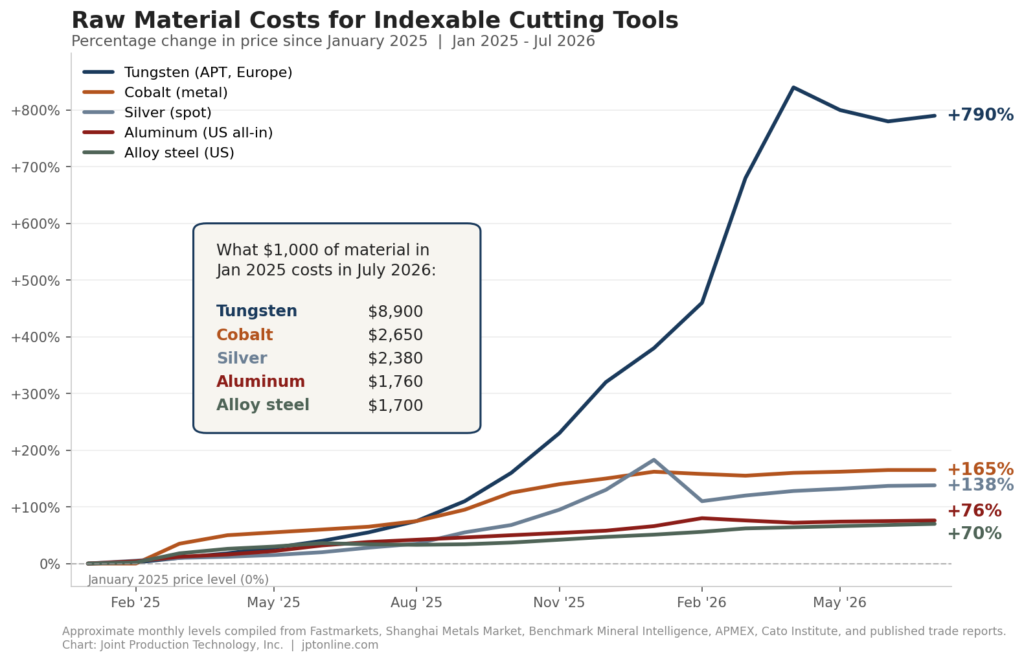
One picture of the whole problem: every major raw material in an indexable cutting tool costs more than it did in January 2025 — tungsten dramatically so. $1,000 of tungsten then is roughly $8,900 now.
Tungsten: The Core of Rising Cutting Tool Material Costs
Tungsten carbide is the foundation of modern metal cutting. It is also one of the most geographically concentrated materials on earth. China controls roughly 80% of global tungsten mine production and dominates the downstream processing chain that converts ore into the ammonium paratungstate (APT), tungsten powder, and carbide powder that toolmakers depend on (The Oregon Group, April 2026).
In early 2025, China imposed dual-use export controls on tungsten products. Exports of processed tungsten fell dramatically — APT export volumes dropped nearly 70% from 2024 levels through most of 2025. The result: the Rotterdam APT benchmark, the reference price for Western tungsten buyers, has risen approximately 900% over the past twelve months, trading above $3,100 per metric ton unit as of spring 2026 (Fastmarkets tungsten pricing).
Demand is moving in the wrong direction for buyers, too. Tungsten is now classified as a critical defense material in the United States, and a January 1, 2027 procurement deadline will bar Chinese and Russian tungsten from key U.S. military applications — just as the U.S. currently has no domestic tungsten mine production. New Western mines are coming, but most analysts expect elevated pricing to persist for 18 to 24 months until alternative supply is established (Diamond Ground Products, April 2026).
Cobalt: The Binder Nobody Talks About
Cemented carbide is tungsten carbide grains held together by a cobalt binder — typically 6% to 12% of an insert by weight. Cobalt has its own supply crisis. The Democratic Republic of Congo produces roughly 70% of the world’s cobalt. In February 2025, the DRC banned cobalt exports outright, then replaced the ban with strict quotas capping 2026 and 2027 exports at 96,600 tonnes per year — roughly half of 2024 production levels (Benchmark Mineral Intelligence). Cobalt metal prices have climbed approximately 160% since early 2025, reaching about $26 per pound by mid-2026.
Every carbide insert carries both of these cost curves at once.
Silver: Brazing Just Got Expensive
Brazed carbide tooling — including the brazed-tip designs common in special tooling — depends on silver-bearing filler alloys, typically 35% to 56% silver content. Silver opened 2025 near $30 per ounce, more than doubled during the year, and set an all-time record above $120 per ounce in late January 2026 before settling into the $70-plus range — still more than double where it stood 18 months ago (APMEX silver price history). J.P. Morgan forecasts silver averaging around $81 per ounce in 2026, more than double its 2025 average (J.P. Morgan Global Research). For brazed tooling, the filler metal alone has become a meaningful line item.
Steel and Aluminum: The Tariff Layer
Tool bodies, cartridges, arbors, and fixturing are made from alloy steels and aluminum. Section 232 tariffs on steel and aluminum were raised to 50% in June 2025, and as of April 2026 those duties apply to the full customs value of covered articles and derivatives (GHY International, June 2026). US benchmark hot-rolled steel now costs about 70% more than it did in February 2025 when the universal tariffs were announced, and roughly 146% more than the world export price (Cato Institute, July 2026). Alloy tool and die grades are under even greater pressure than carbon steel, because the chromium, molybdenum, and vanadium that define them come from the same strained critical-minerals supply chains driving everything else on this page (FCS Steel alloy price analysis).
The U.S. Midwest aluminum premium — the regional surcharge every domestic aluminum buyer pays — hit a record $2,182 per tonne in February 2026, crossing $1 per pound for the first time in history and putting all-in U.S. aluminum costs roughly 70% above world prices (MarketMinute, February 2026). Whatever one’s view of the policy goals, the near-term effect on domestic manufacturers who buy these metals is unambiguous: higher input costs.
Here is why a 70% steel increase matters as much as a 900% tungsten increase: percentage times mass. A carbide insert weighs a few grams; the alloy steel body of a large motion tool — a boring bar, a multi-spindle arbor, a differential case tool — can weigh tens or even hundreds of pounds. On big tooling, the steel that makes up the overwhelming majority of the tool’s mass can contribute as many absolute dollars of cost increase as the carbide that makes the headlines.
Coatings: One More Layer of Cutting Tool Material Costs
Modern PVD and CVD tool coatings depend on titanium, chromium, aluminum, and other metals drawn from the same strained critical-minerals supply chains described above. Coating costs track the metals markets, and they are tracking upward.
Why Lead Times Are Stretching, Not Just Prices
There is a second-order effect that hits customers just as hard as price: availability. Volatile markets punish anyone holding inventory. A distributor who stocks carbide rod or tungsten powder bought near a peak takes the full loss if prices retrace — and these markets do retrace. Silver fell roughly 35% from its January record within weeks before recovering, and Chinese tungsten benchmarks dropped sharply month-over-month in June before rebounding (Shanghai Metals Market, June 2026). What goes up fast can come down faster.
The rational response up and down the supply chain has been to hold as little inventory as possible — decades of just-in-time discipline reinforced by repricing risk in both directions. The result is that material lead times are stretching even when material physically exists, because nobody between the mine and your spindle wants to own it a day longer than necessary. For tooling buyers, this means lead time is becoming as important a planning variable as price. Projects that once allowed tooling to be ordered late in the launch cycle now reward early tooling engagement — and penalize waiting.
What Rising Cutting Tool Material Costs Mean for Your Machining
Here is the honest summary: the cost of making a cutting tool has risen substantially, the causes are structural rather than cyclical, and no toolmaker — domestic or foreign — is exempt.
At JPT, every tool we build is a special, quoted individually for the job. That means there is no price list to raise; each quote is a snapshot of material markets at the moment it is written. If a quote today looks different from what a similar project cost two or three years ago, this article is the reason. The tungsten in that insert, the cobalt binding it, the silver brazing it, and the steel body carrying it all cost dramatically more than they did then — for everyone, everywhere. It also means quote validity windows across the industry are getting shorter — and here is a first-hand data point on why: some of the material quotes JPT receives from our own suppliers are now valid for five days or less. When the mills and powder producers upstream of us will not hold a number for a week, no toolmaker downstream can responsibly hold one for six months.
The good news is that the quote-every-job model cuts both ways. Because we engineer each tool for its specific application, we can design around expensive materials rather than simply passing them through. An indexable tool concentrates its costly carbide in a small, replaceable insert while the tool body — the majority of the mass — lives on for years. Well-engineered indexable systems that maximize cutting edges per insert, extend edge life through proper application engineering, and preserve tool bodies across product generations become dramatically more economical than solid carbide alternatives or poorly optimized designs. That has been JPT’s engineering philosophy since 1971, and the current market has turned it from a preference into a financial imperative.
If rising tooling costs are pressuring your operations, this is exactly the right time to review your tooling strategy across the industries we serve. Call us at 586-786-0080 or contact us here — we will show you where the savings are.

The JPT Difference
Have a new project or tooling challenge? Let’s talk. Our team is ready to help you find the most cost-effective solution for your specific application.
The JPT Way
Most tooling problems aren’t solved by buying off the shelf. They’re solved by understanding the application, the machine, and the process — then engineering the right solution.
Cutting tools. Fixturing. Complete production solutions. That’s been the JPT way since 1971. No catalogs. No guessing. Just engineering.

